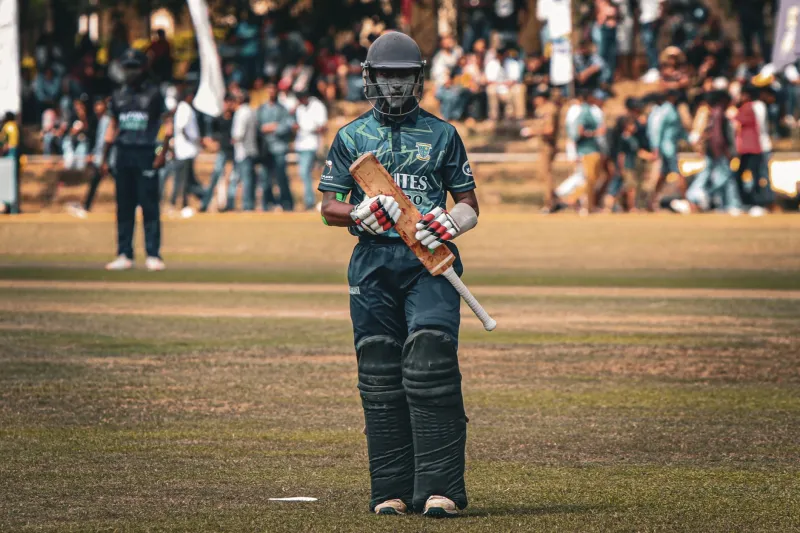
The Calculator That Decides Champions: How a Math Formula Became Cricket's Most Hated Referee

Picture this: the World Cup final, one team needs 40 runs off 30 balls, the stadium is buzzing — and then the sky opens up. Players jog off, tarps come out, and when play resumes 45 minutes later, the target has changed. Not because anyone scored. Because a formula said so.
Welcome to the Duckworth-Lewis-Stern method, or DLS — the piece of math that every cricket fan loves to argue about and every bettor learns to respect real fast.
Why Rain Messes Everything Up
Unlike baseball, where a rainout just gets rescheduled or picked up later, cricket matches often can't be replayed. Tournaments run on tight schedules, and a limited-overs match is a one-night event. So when weather eats into playing time, the game has to be adjusted on the fly.
The problem is simple to state and hard to solve: if Team B only gets 40 overs instead of 50 to chase, what's a fair target? You can't just scale it down proportionally, because chasing teams lose a resource — overs — that's more valuable late in a match than early.
Enter the Formula
The original Duckworth-Lewis method, cooked up by two British statisticians in the 1990s, models a chase as a curve of "resources remaining" — a blend of overs left and wickets in hand. Lose overs to rain? Your resource total drops, and the target gets recalculated accordingly. Lose wickets? Same deal, and it stings more the earlier it happens.
It got the "Stern" added in 2014 when economist Steven Stern tweaked the curves to better fit modern, high-scoring games. Today it's the global standard.
If you're a numbers person, think of it like a win-probability model that's actually written into the rulebook. If you're not, just know this: the scoreboard you see after a rain break is the one that counts.
The American Comparisons (Sort Of)
Nothing in US sports maps perfectly, but there are cousins:
- NASCAR shortens races for weather all the time — pass halfway, and the leader wins. It's abrupt, but at least it's simple. DLS is NASCAR's rain-shortening with an actuarial spreadsheet attached.
- MLB's old rain-shortened game rule (now mostly retired in favor of resumed games) decided results off incomplete contests — which drove bettors absolutely nuts back in the day.
- College football and the NFL have overtime rules that change strategy mid-game. DLS does that, except the strategy shift happens the moment clouds gather.
The key difference: in American sports, weather usually delays the outcome. In cricket, weather often is the outcome.
Why Bettors Care — A Lot
Here's where it gets interesting if you're looking at odds. Live cricket lines move on everything — a wicket, a big over, a fielding mistake. But nothing flips a market like a rain cloud rolling in.
That's because DLS doesn't just change the target; it changes the shape of the chase. A team that was comfortably ahead under the original target can suddenly be behind under the revised one. Sportsbooks and exchanges reprice in real time, and sharp bettors are watching radar apps as closely as the broadcast.
A few practical things that move lines during a rain delay:
- How many overs are lost — small interruptions barely move things; long ones can flip the favorite entirely.
- Wickets in hand — a chasing team that's 3 down gets hammered by DLS far worse than one that's 1 down.
- The toss and conditions — teams that win the toss in humid climates sometimes choose to bowl first because chasing under DLS is more predictable.
If you're new to cricket wagering, treat weather like you'd treat a star QB's injury status in football: check the forecast before you lock anything in.
The Strategy Nobody Teaches You
DLS doesn't just affect bettors — it warps how teams play. Captains think in "par score" terms, always aware of where they stand relative to the adjusted target. A batting side might accelerate aggressively not to win, but to build a DLS buffer before the sky opens. Bowling sides change plans to take wickets precisely because each wicket quietly shrinks the opponent's mathematical resources.
It's a bit like an NFL team playing for field position and time of possession in the fourth quarter — except the clock is invisible and partially controlled by the weather.
Is It Fair? Fans Say No, Math Says Mostly Yes
Every few years, a big match gets decided by DLS and the debate reignites. Critics call it a black box that punishes teams for the weather. Defenders point out that the alternatives — bowl-offs, coin flips, averaging run rates — are all worse. The 1992 World Cup famously saw South Africa's target balloon absurdly under the pre-DLS rain rule, which is exactly why the formula exists in the first place.
The honest answer: DLS is the least-bad solution to an inherently unfair problem. It's the umpire you can't argue with because it doesn't have ears.
The Takeaway for New Fans
If you're coming from baseball or football, the biggest mental shift is this: in cricket, the forecast is part of the box score. Learn the basics of DLS, keep an eye on the sky during a chase, and you'll understand why a seemingly comfortable position can evaporate faster than a puddle on a Texas sidewalk in July.
And if you're betting on it? Do what the pros do — check the radar, check the resource table, and never assume the scoreboard tells the whole story until the final ball is bowled.